Summary : Prosthetic gait training is an important part of rehabilitation for people learning to walk with a lower-limb prosthesis. It focuses on balance, posture, weight transfer, step control, coordination and safe movement. This guide explains what prosthetic gait training involves, why it matters, common exercises, factors that affect progress, and how the right prosthetic components can support everyday mobility.
Receiving a prosthetic limb is an important step, but using it comfortably and confidently takes practice. Walking with a prosthesis changes how the body manages balance, movement and weight distribution. Rehabilitation helps the user gradually develop better control and adapt to these changes.
Gait training is not limited to taking steps on a flat surface. It can include standing, weight shifting, walking with support, turning, using stairs and managing different walking environments. The exact approach depends on the person’s amputation level, strength, balance, residual-limb condition, prosthetic setup and daily goals.
What Is Prosthetic Gait Training And How Does It Work?
Prosthetic gait training is a structured rehabilitation process that teaches a person how to use a prosthetic limb during standing and walking. The aim is to develop controlled and efficient movement while reducing unnecessary compensation.
Training often starts with basic activities such as standing with the prosthesis, shifting weight from one side to the other and maintaining balance. Once these skills become more comfortable, the person can progress to stepping and walking with support. Depending on progress, walking aids may gradually be reduced.
The therapist may observe posture, foot placement, step length, walking rhythm and how the prosthetic side accepts weight. Feedback may be provided through verbal instructions, physical guidance, mirrors or other techniques. Research on lower-limb amputation rehabilitation supports both overground and treadmill-based gait training for improving different aspects of walking.
Why Is Prosthetic Gait Training Important After Amputation?
A prosthetic limb can restore an important part of mobility, but the body still has to learn how to use it. Learning how to manage everyday walking situations can improve confidence and make movement feel more predictable. The adjustment to a prosthetic limb can also involve emotional and social challenges, making it useful to understand the psychological impact of prosthetic devices on amputees alongside the physical aspects of rehabilitation.
Gait training can help with several important areas.
Better Weight Transfer
Learning to place and shift weight correctly through the prosthetic side is a basic part of walking. Proper weight transfer supports stability and helps the person become more comfortable using the prosthesis during the stance phase.
Improved Balance And Stability
Balance becomes especially important when standing on different surfaces, turning or moving without constant support. Training gradually challenges balance and coordination as the person’s abilities improve.
More Controlled Walking
Gait training works on step timing, posture, stride and movement symmetry. These areas can help reduce unnecessary compensatory movements and make walking more controlled.
Greater Walking Efficiency
People with lower-limb amputation may use more energy while walking because of altered biomechanics. Gait training is intended to improve movement efficiency and functional mobility rather than simply increase walking speed.
More Confidence In Daily Activities
Learning how to manage everyday walking situations can make movement feel more predictable. Training may eventually include stairs, ramps, obstacles and outdoor surfaces.
What Are The Main Stages Of Prosthetic Gait Training?
Prosthetic walking is usually developed gradually rather than learned in a single session.
Preparing For Prosthetic Walking
Before focusing heavily on walking with a prosthetic leg, rehabilitation may address muscle strength, joint movement, balance, residual-limb care and general conditioning. The person may also learn how to put on and remove the prosthesis correctly and how to look after the skin.
Learning Standing And Weight Shifting
The next step often involves becoming comfortable while standing with the prosthesis. Weight-shifting exercises teach the user how to move the body over the prosthetic side while maintaining control.
Walking With Support
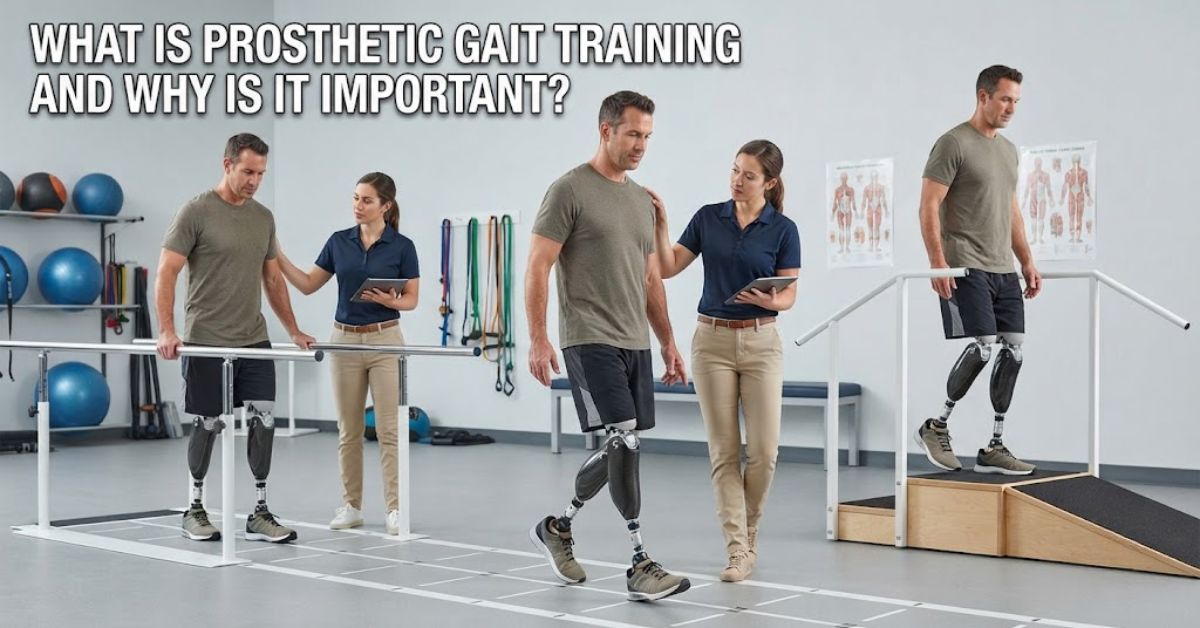
Walking may begin between parallel bars or with another suitable walking aid. For beginners, gait training with parallel bars can provide a stable environment to practise weight shifting, balance and controlled steps before progressing to less support. The focus is on safe foot placement, posture, weight acceptance and controlled steps.
Developing A Better Walking Pattern
As control improves, training may focus more closely on stride length, timing, pelvic movement, posture and symmetry. The therapist can identify movement patterns that may need correction.
Practising Functional Mobility
Later training can include turning, side stepping, backward stepping, stairs, obstacles and different surfaces. Functional gait practice helps connect therapy skills with real-life activities.
What Exercises Are Used In Prosthetic Gait Training?
Exercises are selected according to individual ability and rehabilitation goals. Common activities may include:
- Weight-shifting from side to side
- Forward and backward stepping
- Side stepping
- Supported standing balance
- Step-touch exercises
- Sit-to-stand practice
- Walking between parallel bars
- Walking with a walker, crutches or cane
- Turning in different directions
- Stair practice
- Walking around or over obstacles
Strength and balance exercises may also be included because good muscle control contributes to stable prosthetic walking. Training programs can be progressed by changing support, repetitions, resistance, walking distance or task difficulty.
These exercises should be performed under appropriate professional guidance, particularly during early prosthetic rehabilitation.
What Factors Can Affect Prosthetic Gait Training?
Every person follows a different rehabilitation path. Several factors can influence how gait training is planned and progressed. The level of amputation is one consideration. A person with a transtibial amputation may have different training requirements from someone with a transfemoral amputation. Muscle strength, joint range of motion, balance, endurance and previous activity level also matter.
The condition of the residual limb and the prosthetic socket are equally important. An uncomfortable or poorly fitting socket can affect weight bearing, stability and walking mechanics. Research involving prosthetic users and rehabilitation clinicians has identified socket fit as a major factor affecting lower-limb prosthetic rehabilitation. The choice of components can also depend on the person’s activity level, environment and functional goals.
How Does Proper Prosthetic Fitting Support Gait Training?
A prosthesis needs to work with the user’s body, not simply replace the missing limb. Socket comfort, suspension, alignment and component selection can influence how someone stands and walks. When the socket does not provide an appropriate fit, the user may avoid putting weight on the prosthetic side or change their movement to compensate for discomfort. This can interfere with gait training and make everyday activities harder. Regular assessment by the prosthetic and rehabilitation team can help identify whether changes are needed.
Gait training and prosthetic fitting should therefore be viewed as connected parts of rehabilitation rather than completely separate steps. Socket comfort, suspension and alignment can influence how someone stands and walks. Evidence-generated prosthetic sockets are also being studied as an approach to improving socket design based on the experiences and needs of people using transtibial prostheses.
What Are The Benefits Of Completing Prosthetic Gait Training?
Consistent gait training can contribute to improved control of prosthetic walking and better functional mobility. Depending on the individual, rehabilitation may help with balance, weight transfer, coordination, walking mechanics and endurance.
The goal is not always to make walking look completely symmetrical. Instead, rehabilitation focuses on helping the person move as safely, comfortably and efficiently as practical for their specific situation.
Progress may also be measured using functional assessments that look at mobility, balance, walking ability and confidence.
When Should You Seek Professional Prosthetic Gait Training?
Professional support can be helpful when someone is learning to use a new prosthesis, experiencing repeated instability or noticing changes in walking.
It is also worth discussing concerns with the rehabilitation team when there is persistent socket discomfort, skin irritation, new limping, frequent stumbles, difficulty with stairs or an unexpected change in balance.
Gait training can also be revisited later. A person who has used a prosthesis for years may still benefit from reassessment when their goals, activity level, prosthetic components or walking environment change.
How Can Prosthetics Manufacturers Help With Rehabilitation?
Prosthetic manufacturers and technical suppliers can support the clinical team by providing components designed for different mobility requirements. Depending on the prosthetic prescription, this may include feet, knee systems, silicon liners, suspension products and other prosthetic components.
Component selection should consider the user’s amputation level, mobility requirements, environment and rehabilitation goals. Research has noted that factors such as activity level, amputation level, strength, environment and functional goals can influence prosthetic prescription.
Reliable component availability and technical information can also help prosthetists select and maintain suitable solutions as a person’s needs change.
Take The Next Step With The Right Prosthetic Support
The right prosthetic components can play an important role in comfort, stability and everyday mobility. Proactive Technical Orthopaedics Pvt. Ltd. supports prosthetic professionals with reliable solutions for different rehabilitation and mobility requirements, helping them select components suited to specific applications.
Looking for the best prosthetics manufacturer in India? Discuss your prosthetic component requirements, product information and technical support. Speak with our team today and get the assistance you need for your next prosthetic solution. Reach out to us for product details and technical assistance.
Frequently Asked Questions
What Is Prosthetic Gait Training?
Prosthetic gait training is a rehabilitation process that helps a person learn to stand, balance and walk safely and efficiently with a prosthetic limb.
Why Do Prosthetic Users Need Gait Training?
Prosthetic users need gait training to learn how to maintain balance, transfer weight, coordinate movements and walk safely with their prosthetic limb. Training also helps them adapt to everyday activities such as turning, climbing stairs and walking on different surfaces.
How Long Does Prosthetic Gait Training Take?
There is no single timeline for everyone. Training duration depends on factors such as amputation level, strength, balance, residual-limb condition, prosthetic fitting and individual mobility goals.
What Exercises Are Used In Prosthetic Gait Training?
Common exercises include weight shifting, supported standing, stepping, balance activities, walking with an assistive device, turning, stair practice and obstacle training.
Can Prosthetic Gait Training Improve Walking?
Gait training can improve different aspects of walking, including movement patterns, spatiotemporal measures and walking distance. Studies have examined both overground and treadmill-based approaches in lower-limb amputee rehabilitation.
Who Provides Prosthetic Gait Training?
Prosthetic gait rehabilitation commonly involves professionals such as physiotherapists and prosthetists, with other healthcare professionals involved when appropriate. The rehabilitation plan is tailored to the individual’s clinical and functional needs.