
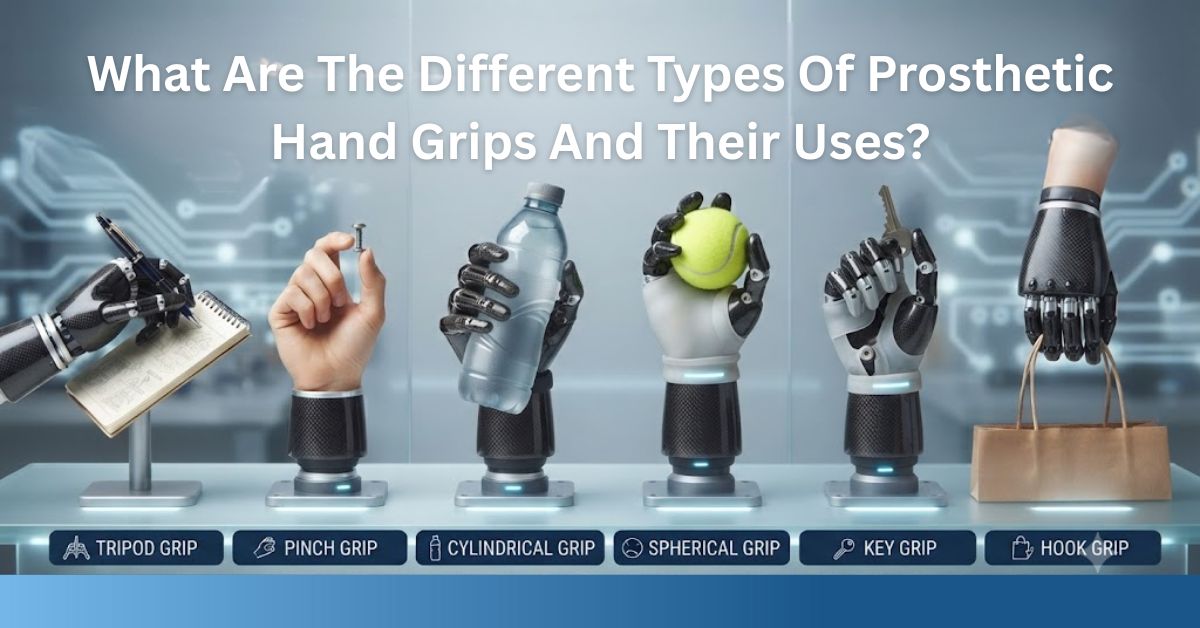
Summary : Different prosthetic hand grips are designed to help users perform specific movements and handle different types of objects. From picking up a coin or holding a pen to carrying a bag or gripping a bottle, each grasp pattern serves a particular purpose. This blog explains the main types of prosthetic hand grips, their everyday uses, how they are controlled, and what factors should be considered when selecting a suitable prosthetic hand.
A prosthetic hand is much more than an artificial replacement for the hand. Its usefulness depends on how effectively it can help a person grasp, hold, release, and manipulate objects during daily activities. Modern prosthetic hands can offer several grasp patterns, while simpler systems may provide more limited movement.
The right grip depends on the person’s limb level, lifestyle, occupation, control method, comfort, and rehabilitation goals. Different users may also need different combinations of grips depending on what they regularly do at home, at work, or during recreational activities.
What Are Prosthetic Hand Grips And Why Do They Matter?
A prosthetic hand grip refers to the position and movement used by the artificial hand to hold or manipulate an object. Human hands naturally change their shape according to the size, weight, texture, and purpose of an object. Prosthetic hands are designed to reproduce some of these useful grasp patterns.
Research commonly identifies tip, tripod, lateral pinch, hook, spherical, and cylindrical grips as important patterns for activities of daily living. These can broadly be associated with precision handling or more secure, conforming forms of grasping.
Having suitable grip options can make everyday tasks more manageable because different objects require different hand positions. A key, for example, needs a different grasp from a water bottle or a shopping bag.
What Are The Different Types Of Prosthetic Hand Grips?
Pulp Or Tip Grip
A pulp or tip grip involves bringing the thumb and fingertip together to hold a small object. It is mainly useful when accuracy and controlled handling are more important than applying a large amount of force.
This grip can be useful for picking up coins, small components, pieces of paper, buttons, or other lightweight items. The movement is particularly valuable when an object needs to be picked up carefully rather than simply secured in the palm. Pulp or tip grasp is included among the commonly assessed prosthetic hand grip patterns.
Tripod Grip
A tripod grip generally uses the thumb, index finger, and middle finger together. It resembles the way a person holds a pen or pencil and provides a combination of control and stability.
Users may find this type of grip useful for holding a pen, marker, small cylindrical objects, utensils, or other items that require controlled positioning. Tripod grasp is one of the established grasp patterns used to assess multifunction prosthetic hands.
Lateral Pinch Grip
A lateral pinch, often associated with a key-pinch position, holds an object between the thumb and the side of a finger. It is particularly useful for thin or flat objects that need to be held securely.
Typical examples include holding a key, card, paper, or similar flat item. Because the grip allows controlled contact with relatively small objects, it can support several common hand-manipulation tasks. Lateral pinch is recognised as one of the important precision grasp patterns in upper-limb prosthetic function.
Hook Grip
A hook grip positions the fingers in a curved, hook-like shape. Instead of relying mainly on the fingertips for precision, it can help support objects with handles.
A common example is carrying a shopping bag or briefcase. It may also be useful for holding handled household items or supporting objects where a suspended load needs to stay secure. Hook grip is one of the principal grasp patterns evaluated in prosthetic hand testing.
Cylindrical Grip
A cylindrical grip is formed when the fingers and thumb wrap around a cylindrical object. The hand creates contact around the object rather than holding it only at one small point.
This grip can be used for bottles, cups, cans, handles, containers, and some tools. Cylindrical grasp is especially relevant for everyday objects because many household items have rounded or elongated shapes. Prosthetic hand assessments commonly use objects such as cans and drills when evaluating cylindrical grasp.
Spherical Grip
A spherical grip is used when the fingers curve around a rounded object. The thumb and fingers work together to create a stable hold around the object’s surface.
This can be useful for holding balls, rounded containers, and other similarly shaped items. The size and shape of the object can affect the way the fingers need to position themselves, which is why adjustable or multi-grasp prosthetic hands can be useful for varied activities.
Extension Grip
An extension grip involves an open or extended hand position that can help with flat or larger objects. It can also be useful for positioning the hand before another grasp or interacting with objects that do not require the fingers to wrap tightly around them.
Examples can include supporting a plate, handling a box, or stabilising a flat item. Extension grip is included among the grasp patterns used in modern prosthetic hand assessment protocols.
How Do Prosthetic Hand Grips Help With Everyday Activities?
Different grips can support a wide range of daily routines, including eating, dressing, writing, carrying objects, handling a phone, opening doors, and picking up small items. Research on upper-limb prosthesis users highlights grasping and manipulation tasks involved in activities such as handling utensils, managing clothing, using mobile phones, and opening doors.
One activity may also involve more than one grip. A person might use a precision grip to pick up a small object and then change to a cylindrical grip to hold it securely. The ability to switch between hand positions can therefore be useful when several movements are required within the same task.
How Do Myoelectric And Body-Powered Hands Control Different Grips?
Prosthetic hand grip control is closely connected with how the complete prosthetic arm functions. Understanding how prosthetic arms work can make it easier to see how signals, mechanical movement, and hand components work together during different activities.
How Does A Myoelectric Prosthetic Hand Work?
A myoelectric hand uses electrical activity generated by muscles to control movement. Electrodes placed against the skin detect muscle activity, and the signals are used to activate the prosthetic hand. Some multi-articulating hands allow the fingers and thumb to move in coordinated or individually controlled patterns. The number and type of available grips depend on the specific prosthetic design and control system.
How Does A Body-Powered Prosthetic Hand Work?
Body-powered prostheses generally use a mechanical cable and harness system. Movement of the shoulder, chest, or upper arm can create tension in the cable, allowing the terminal device or hand to open and close. These systems can provide practical mechanical control and are used for a range of functional activities. The appropriate design depends on the user’s physical abilities, daily requirements, and desired functionality.
How Do You Choose The Right Prosthetic Hand Grip For Your Needs?
There is no single grip pattern that suits every prosthetic user. Selection should be based on what the person actually needs to do throughout the day. Factors to consider include the level of limb loss, daily activities, occupation, hobbies, object sizes, desired grip strength, control method, socket comfort, and rehabilitation goals. Individual needs can vary significantly, so prosthetic selection, socket design, control, and training should be considered together.
For someone who frequently writes or handles small objects, precision grips may be particularly relevant. A person who regularly carries bags or works with larger objects may place greater importance on secure grasping patterns.
For users with a below-elbow amputation, understanding how to choose a transradial prosthesis can also help when considering grip control, hand function, comfort, and everyday activities.
What Should You Consider Before Selecting A Prosthetic Hand?
Start by identifying the activities that matter most to the user. Think about the objects they handle regularly and whether their routine requires greater precision, stability, strength, or a combination of these functions.
It is also useful to consider the number of grip patterns required, the preferred control method, socket comfort, maintenance requirements, training, and the environment in which the prosthesis will be used. Activity-specific prosthetic options may also be appropriate for particular jobs, sports, hobbies, or specialised tasks.
Why Do Proper Fitting And Training Matter For Prosthetic Hand Grips?
A prosthetic hand may offer several grip options, but using them effectively requires more than simply having the technology. Proper socket fit, alignment, control training, and repeated practice can influence how comfortably and accurately a user performs everyday activities.
Rehabilitation can help users learn when to select a particular grip and how to coordinate the prosthetic hand with the rest of the arm. Training is especially relevant for multi-grasp systems where several hand positions are available. Studies of prosthetic hand use also show that users may rely on a smaller number of grips during everyday home activities than during structured testing, highlighting the importance of practical training around real-life tasks.
How Can A Prosthetics Manufacturer Help With Grip Functionality?
A prosthetics manufacturer can contribute to the development and supply of components that support different functional requirements. This may include hand mechanisms, finger and thumb components, mechanical parts, connection systems, and other prosthetic solutions.
Manufacturers can also work alongside prosthetists and rehabilitation professionals to support component compatibility, product requirements, customisation needs, and technical considerations. The final selection should be based on the user’s clinical assessment and functional goals rather than on the number of available grips alone.
Good component selection is particularly important when the prosthetic hand needs to perform repeated movements in daily life. The design, materials, control system, and mechanical characteristics can all influence how effectively a prosthetic hand performs different grasping tasks.
Why Choose Proactive Technical Orthopaedics?
Choosing the right prosthetic component partner can support better product selection, functionality, and long-term usability. Proactive Technical Orthopaedics focuses on providing prosthetic solutions that meet different technical and functional requirements.
- Quality-Focused Prosthetic Components: Provides prosthetic components designed to support reliable performance and everyday functionality.
- Wide Range Of Solutions: Offers different prosthetic component options to meet varied user and professional requirements.
- Functional Approach: Focuses on components that support movement, comfort, control, and practical prosthetic use.
- Technical Support: Helps prosthetic professionals understand product features, applications, and component requirements.
- Professional & User-Centred Solutions: Works toward providing prosthetic solutions that align with individual functional needs and application goals.
Find Components That Fit Your Prosthetic Requirements
The right prosthetic components can support comfortable movement, reliable control, and practical functionality during everyday activities. Proactive Technical Orthopaedics Pvt. Ltd provides prosthetic component solutions for different functional and technical requirements. As the best prosthetics manufacturer in India, we focus on providing quality solutions that support the needs of prosthetic professionals and users.
Looking for a dependable partner for prosthetic component requirements? Contact us to discuss your product needs, application requirements, and technical queries. Contact us today to learn more about our prosthetic solutions and discuss how we can support your requirements.
Frequently Asked Questions
What Is The Most Common Grip Used In A Prosthetic Hand?
There is no single grip that is appropriate for every activity or user. Power, pinch, lateral, cylindrical, tripod, hook, and other grips can be used for different everyday tasks.
How Many Different Grips Can A Prosthetic Hand Have?
The number varies according to the prosthetic hand and its control system. Basic devices may offer limited movement, while multi-articulating hands can provide several different grasp patterns.
Which Prosthetic Hand Grip Is Used For Holding A Key?
A lateral pinch grip is commonly used for holding a key or other thin object between the thumb and side of the finger.
Which Grip Is Useful For Carrying A Bag?
A hook grip can be useful for carrying bags, briefcases, and other objects with handles because the fingers form a curved position around the handle.
Can A Prosthetic Hand Have Multiple Grip Patterns?
Yes. Some prosthetic hands are designed to provide multiple grasp patterns, although the available functions differ between devices. The appropriate choice depends on the user’s functional needs, control system, and prosthetic design.