
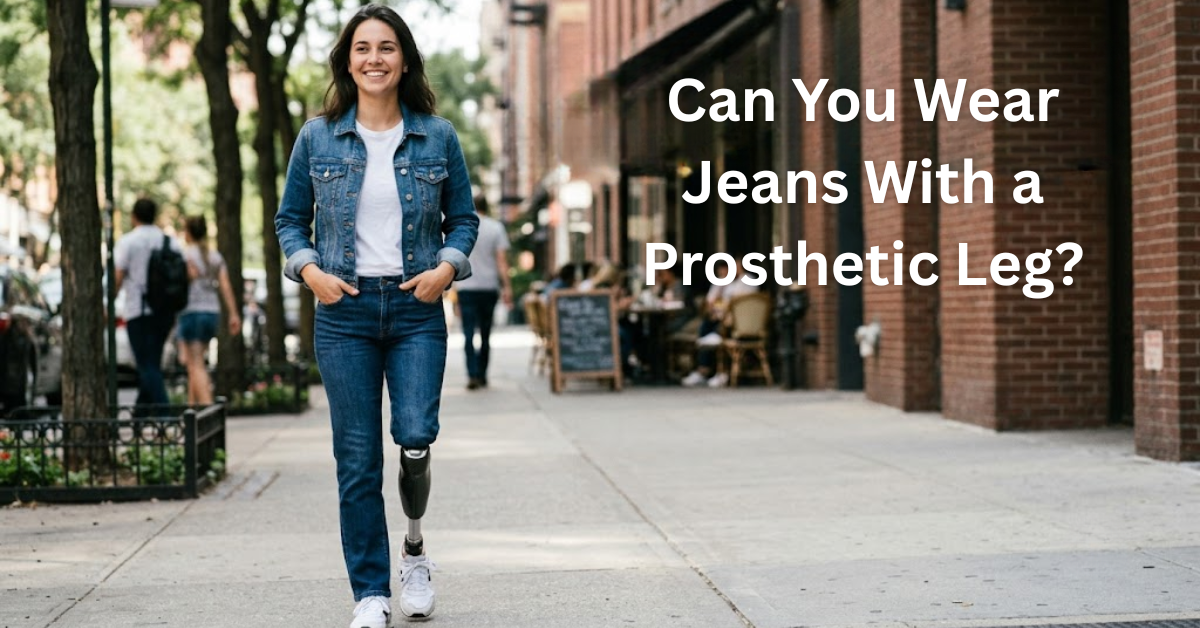
Summary : Yes, many people wear jeans with a prosthetic leg. The most comfortable options usually combine enough room around the socket or knee with flexible fabric and easy access for donning, skin checks, and adjustments. This guide explains how to choose jeans for below-knee and above-knee prostheses, avoid pressure and fabric damage, and modify ordinary denim when needed.
Jeans are an everyday clothing choice, and using a prosthetic leg does not mean giving them up. The practical challenge is that denim must move over a socket, mechanical components, and sometimes a prosthetic knee without becoming too tight or difficult to remove. The best jeans are not necessarily “adaptive” jeans. Many prosthetic users do well with standard straight-leg, relaxed, boot-cut, or stretch-denim styles, sometimes with simple tailoring. Comfort, access, and personal style should guide the choice.
Yes – Jeans Can Work With Most Prosthetic Legs
A prosthetic leg can be worn under jeans, over some components, or partly visible depending on your preference and the prosthetic design. The main requirement is enough space to move without the denim compressing the socket, liner, suspension sleeve, or knee mechanism.
The exact fit depends on whether you use a below-knee or above-knee prosthesis. A slim pylon may fit easily inside standard jeans, while a larger socket or knee unit may need a wider leg opening. The range of prosthetic components used in modern systems means clothing needs can vary significantly from one person to another.
Choose Stretch Denim Instead of Very Rigid Fabric
Denim with a small amount of stretch is usually easier to pull over a prosthesis and more comfortable when sitting or bending. Extremely rigid denim can bunch at the socket edge or restrict movement around an above-knee joint. Stretch also makes it easier to check the limb or adjust socks during the day.
Look at how the fabric behaves when you sit, climb a step, and bend the knee. Jeans that feel fine while standing may become tight across the thigh or socket when seated.
Straight-Leg and Relaxed Fits Are Often the Easiest
Straight-leg jeans are a practical starting point because the opening is usually wide enough to pass over many prosthetic feet and lower components. Relaxed-fit jeans provide more room at the thigh and knee and can reduce friction around hardware.
Skinny jeans can work for some people, but they are less forgiving. If you prefer a slim look, choose highly flexible fabric and test whether you can put the jeans on and take them off without forcing the prosthesis through the leg opening.
Below-Knee Prosthesis: What to Check
Below-knee users retain their natural knee, so pay attention to the socket brim, suspension sleeve, and calf area. Tight fabric can rub against a sleeve or make it difficult to reach a lock-release button. If you use a pin-lock or other suspension system, make sure the jeans do not interfere with access.
The prosthetic foot also needs to pass through the hem. Some shoes and prosthetic feet have a wider profile, so test the complete combination of foot, shoe, and jeans rather than the jeans alone.
Above-Knee Prosthesis: Leave Room for the Knee
Above-knee users need enough space for the socket and prosthetic knee to flex freely. Very tight denim around a mechanical knee can catch, pull, or wear more quickly where the component repeatedly moves.
A mid- or high-rise waist can also be more comfortable for some users because it provides coverage around a higher socket. When selecting an above-knee system, prosthetic knee joint options and socket design can influence how clothing sits and moves.
Try the Seated Test Before Buying
Do not judge jeans only while standing in front of a mirror. Sit in a chair, bend the knee, cross or reposition the legs if that is part of your normal routine, and check whether the waistband, thigh, socket area, or hem becomes uncomfortable.
Also try walking several steps. Watch for fabric catching on screws, adapters, knee covers, or cosmetic components. If the jeans twist around the prosthesis while walking, a slightly different cut may work better.
Simple Tailoring Can Make Regular Jeans Prosthetic-Friendly
A tailor can add an invisible side zipper, enlarge the lower leg opening, reinforce a high-friction area, or adjust one leg differently from the other. This can be more stylish and affordable than replacing an entire wardrobe.
For people who need frequent access to the prosthesis, a zipper along the inner or outer seam can make skin checks, sock changes, or component adjustments easier without removing the jeans.
Protect Both Your Skin and Your Clothes
Clothing should never push hard against a sensitive socket edge or irritated skin. If rubbing occurs, first determine whether it is a clothing problem or a prosthetic-fit problem. A tight garment should not be used to “hold” a loose prosthesis in place.
Mechanical joints and exposed hardware can also wear through denim. Reinforcement patches on the inside of the garment may extend clothing life without changing the visible style.
Footwear and Jeans Should Work as a System
Changing from a flat shoe to a shoe with a very different heel height can affect prosthetic alignment unless the foot is designed to accommodate it. Consider the shoes you usually wear with your jeans and follow the footwear guidance provided by your prosthetist.
If clothing and footwear choices are limiting everyday comfort, custom lower-limb prosthetic fitting can address socket, alignment, and component issues that may be contributing to the problem.
Practical Dressing Routine for Jeans
Many users find dressing easier when seated on a stable chair or bed. One option is to feed the prosthetic foot through the trouser leg before fully donning or fastening the prosthesis, while another is to put on the prosthesis first and then pull the jeans over it. Which method works best depends on socket height, suspension, knee type, and the width of the jeans. Practise both methods in a safe environment and choose the one that requires the least pulling, twisting, and balancing.
Keep access points in mind. If your suspension release, charging port, or adjustment area sits under the jeans, make sure you can reach it without removing most of your clothing. A simple ankle or side zipper can save time during workdays and travel.
Common Jeans Mistakes to Avoid
Avoid buying jeans only because they look roomy while standing. The real test is sitting, bending, walking, and taking them off. Do not force a narrow leg opening over a prosthetic foot because repeated pulling can damage fabric, scuff cosmetic covers, or make dressing unsafe.
Also avoid using very tight denim to conceal socket looseness or reduce prosthetic movement. Clothing cannot replace correct suspension or socket fit. If the limb feels unstable inside the prosthesis, arrange a clinical review.
Dress for Comfort Without Giving Up Your Style
The best jeans are the pair you can put on easily, sit in comfortably, walk in confidently, and remove without struggling. Straight, relaxed, boot-cut, and stretch-denim styles are all useful options, while tailoring can make a favorite pair more practical.
If you are choosing or updating a prosthesis and want a system that works with your everyday wardrobe, explore support from a prosthetics manufacturer and supplier in India that considers real-life comfort as well as technical performance. Contact us to learn more about suitable prosthetic solutions designed to support your daily activities and comfort.
Frequently Asked Questions
Can you wear skinny jeans with a prosthetic leg?
Yes, if the fabric stretches enough and does not restrict the socket, knee, suspension, or skin.
What type of jeans are easiest with a prosthetic leg?
Straight-leg, relaxed-fit, boot-cut, and stretch-denim jeans are often easiest.
Can jeans damage a prosthetic knee?
Normal clothing should not damage a properly protected component, but tight fabric can catch or wear around moving hardware.
Should jeans go over or under a prosthetic socket?
Most trousers go over the socket, but the best arrangement depends on socket height, suspension, and personal preference.
Can a tailor modify jeans for a prosthesis?
Yes. Side zippers, wider openings, reinforcement, and asymmetric tailoring are common practical modifications.
Why do my jeans twist around my prosthetic leg?
The cut may be too narrow, the fabric may catch on components, or the prosthesis may be rotating. Persistent prosthetic rotation should be assessed.
Are stretch jeans better for amputees?
They are often easier to put on and more comfortable during sitting and bending.
Can I wear shorts instead of jeans?
Yes. Many users prefer shorts for easy access and ventilation, but clothing choice is entirely personal.
Do shoes affect how jeans fit over a prosthetic foot?
Yes. A wide shoe or foot shell can make a narrow hem difficult to pull on or off.
Should clothing influence prosthetic selection?
Daily clothing can be discussed during prosthetic planning, but safety, fit, function, and activity needs remain the main priorities.